
Shergold and Weir 'Building Confidence' Report update: What subcontractors need to know
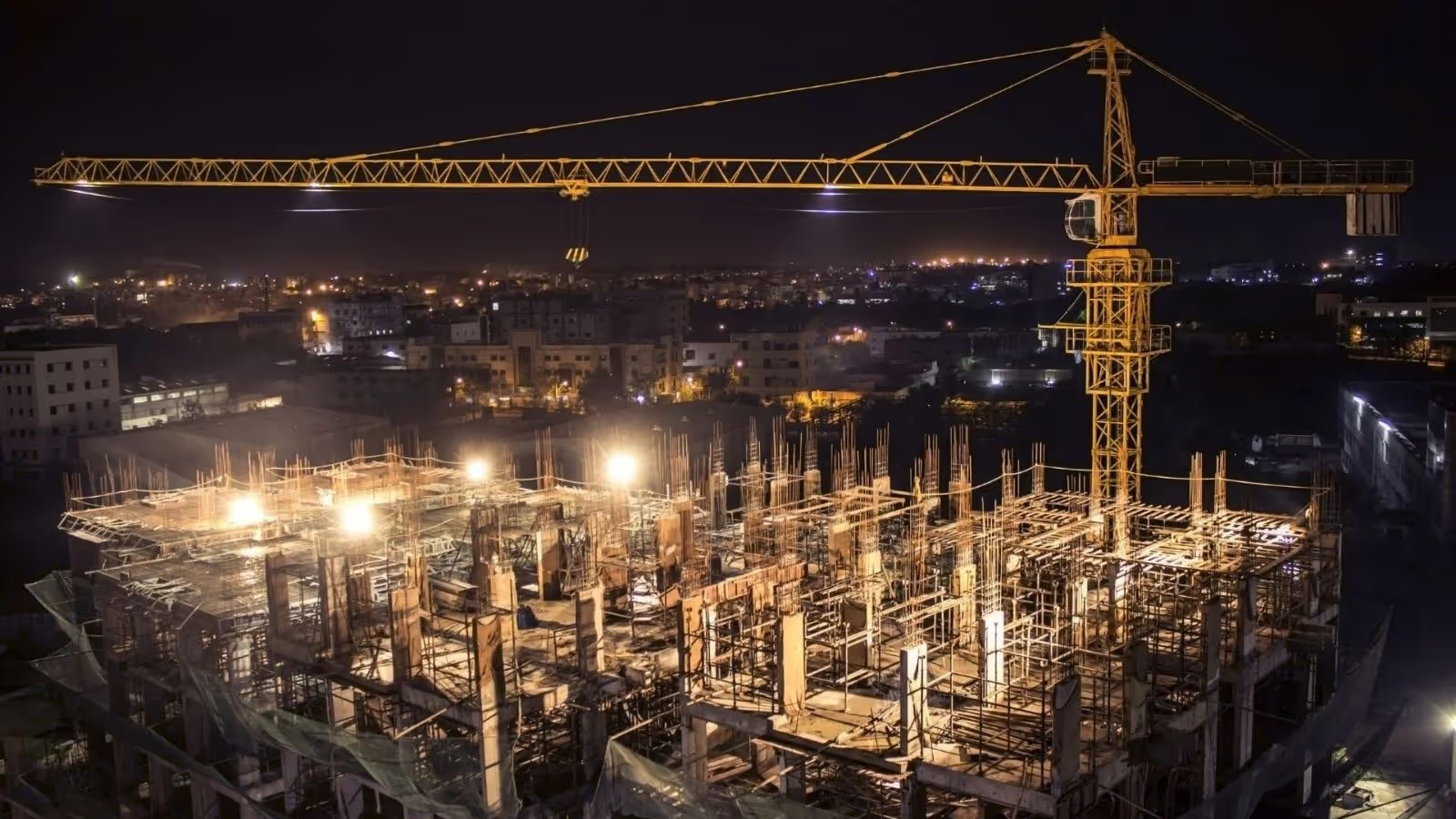
The name 'Opal Towers' sends a shiver down the spine of many people in the construction industry, as it remains one of the most high-profile examples of defective work. It was also one of the catalysts for a major inquiry into the processes and performance of our sector, leading to a raft of reform recommendations in the Shergold and Weir 'Building Confidence' Report.
The report was released in 2018, and the rollout of action on recommendations commenced in fits and starts. One of the recommendations that will be of most immediate value for subcontractors, which is automatic recognition of trade qualifications and credentials across all states and territories, is unfortunately still a work in progress. This is something the industry has been advocating strongly for, particularly as cross-border work is not uncommon in the Eastern States, and it is both costly and time-consuming to maintain dual-state registration status.
For subcontracting firms with a highly mobile workforce and an ever-broader geographic spread of nationwide sites, state-specific registration requirements and blocks around mutual recognition have proven to be a real drain on resources, particularly where a worker has specific skills and expertise that are hard to replace.
Aside from that, the major progress on the reforms has been in the areas of compliance, enforcement and, to some degree, addressing gaps in registration requirements. For example, before the reforms, in New South Wales, the lead contractor on a commercial construction project did not need to be a licensed builder, and anyone could call themselves an engineer! In many states, cowboy tradies were also able to thrive because there were limited requirements for appropriate trade qualifications - and when the cowboys mess up (as they often do) the reputation of genuine tradies takes a battering.
Read on to learn how reforms are progressing around Australia.
Progress in NSW
In New South Wales, the appointment of David Chandler as Building Commissioner, with extensive powers to enter sites, inspect works and halt programs in their tracks, is one of the most obvious outcomes.
His focus has been mainly on Class 2 buildings - multi-residential apartments - as those projects pose the greatest risk in terms of buyer confidence in the quality and safety of our work. Owners of apartments at Mascot in NSW, Opal Towers, and Lacrosse in Victoria have been front and centre in the media explaining the impact of defects on their lives, giving the issues of quality and compliance a human face. The workmanship of formworkers, concreters, waterproofers, electricians, façade installers and plumbers has been questioned and, in some cases, found wanting.
Commissioner Chandler posts regularly on LinkedIn showing photos and giving lengthy descriptions of some of the non-compliant work he comes across, and there have also been financial consequences for projects issued stop work and rectification orders.
The latest stage of reforms in NSW has seen the Office of the Building Commissioner transform into the NSW Building Commission as of 1 December, with an expanded remit, which now includes inspection and enforcement powers for Class 1 residential projects. This means the work done on project homes, for volume builders and for master-planned estates will be in the spotlight.
The Building Commission will also be able to enact inspections and enforcement on already completed Class 2 projects so any latent defects may be detected and addressed. Strata owners can report issues directly via Fair Trading.
Other changes in NSW included requirements for digital lodgement of completed detailed design documentation, enhanced registration requirements for key practitioners, including engineers, waterproofers and some trades, and mandatory training in the National Construction Code for specific groups also.
A recent review of progress on Shergold & Wier by the Australian Construction Industry Forum (ACIF) found that not all states have progressed as far as NSW - but all jurisdictions are at some stage of the journey.
Progress in Victoria
Following the establishment of the state's Cladding Taskforce, further inquiries led to the establishment of the Expert Panel on Building Reform. This body released a report (because nothing says "government" like a report) with recommendations around practitioner registration, consumer representation, regulatory oversight and building approvals. Some of these will be implemented under the Building Legislation Amendment Bill (BLAB) 2023, which was signed off in mid-2023.
Matters that may affect a subcontracting business, whether directly or in terms of the contractors employing them, include requirements for registration of building consultants and site supervisors, changes to registration for draftspersons and project management and a new category of offence where it will become illegal to carry out work as a building practitioner without a registration unless that person is an employee of a registered builder.
The government is also considering introducing mandatory CPD (Continuing Professional Development) for building practitioners and plumbers. There is also likely to be greater emphasis on improving project documentation from all subcontracting trades on a project to meet more stringent requirements around record-keeping, documentation to support inspections and the production of a building manual for the owner, which will contain the essential details of the building's design and construction.
Accurate site diaries and managing evidence in the form of photos, ITPs and design drawings will be absolutely essential!
Progress in Queensland
Queensland has not, to date, introduced anywhere near the level of reform pursued by NSW and Victoria. It already had a mutual recognition scheme for interstate tradies; however, because the trades must demonstrate a similar level of certification to that enshrined in the Queensland standards, many subbies find their NSW, Victorian or other jurisdiction's certification is not sufficient. So, there remains work to be done on this front.
For Class 1a buildings, new requirements under the Building Regulations 2021 legislation mandate inspections at the stages of excavation, footings, slab, frame, and final stages of construction. This affects almost all trades on a project. While there is no specific form of back-up evidence stipulated, keeping good records, particularly around variations, will be invaluable if there are any questions raised about compliance or quality.
The big takeaway
While it's usually the head contractor that gets either the credit or the brickbats for a completed project, every building is the product of the work of subcontractors. Taking pride in our contribution is important, and so is ensuring that we are nailing the detail of quality, accountability, compliance and professionalism. The process of reform is not over - getting on the front foot and ensuring your business is well-placed to stand up to scrutiny is more important than ever.
Read the full ACIF review here.

Frequently Asked Questions
Construction management software for subcontractors is software that helps subcontracting businesses manage crews, schedules, labour hours, compliance requirements and site documentation across multiple projects. It is designed for labour-intensive, site-based work and supports payroll accuracy, EBA and award compliance and the records needed to verify work performed.
Neo is subcontractor operations software built to solve common problems around managing crews, labour hours, compliance requirements and site records across multiple projects. Disconnected schedules, manual timesheets, payroll errors and missing site records lead to rework, disputes and margin leakage. Neo replaces fragmented processes with a single platform that keeps labour data, site activity and compliance aligned across every job.
Neo is subcontractor software used by construction businesses managing crews across multiple sites and projects. This includes a wide range of labour‑intensive, field‑based trades, such as concrete placement, concrete pumping, formwork, steel fixing, civil construction and labour hire, that rely on accurate crew scheduling, labour tracking, site documentation and EBA or award compliance to run their business efficiently
Neo is built for subcontractors of different sizes that manage crews across multiple projects. The subcontractor operations software supports both growing teams and larger subcontracting businesses, scaling as workforce size, project count and operational complexity increase.
Spreadsheets and whiteboards rely on manual updates and are often out of date, leading to missed changes, double booking and fragmented records. Neo is subcontractor software that provides real‑time scheduling, automated crew notifications, linked timesheets and site records in a single platform, ensuring crews in the field and teams in the office work from the same up‑to‑date information.
Neo subcontractor software pricing is structured around packages that scale with your business. Costs depend on factors like workforce size and operational needs, ensuring subcontractors only pay for what they use. A demo is the best way to understand which package fits your business and expected ROI.
Other Blogs
How to build a labour estimate you can actually track against
Is your subcontracting business ready for productivity tracking? Four questions to ask first
Our guide to measuring and tracking labour productivity
Ready to see an easier way to run your subcontracting business?
Get the clarity, accuracy and confidence you need to keep jobs and crews moving.